

May 18, 2026
Important Dates…
Thursday, May 21: Primary Class End of Year Celebration, 6 p.m. in the Gathering Place.
Friday, May 22: Last Day of School for the 2025-2026 school year.
Monday, June 8-Friday, June 12: Summer Camp Week One: Fee, Fi, Fo–Fantasy Fun, 9 a.m. to 1 p.m.
Monday, June 15-Friday, June 19: Summer Camp Week Two: Games and Adventures, 9 a.m. to 1 p.m.
Monday, June 22-Friday, June 26: Summer Camp Week Three: Splish, Splash, Splosh–Water Week, 9 a.m. to 1 p.m.
Thursday, August 20: Ice Cream Social/Open House for Families Enrolled in the 2026-2027 school year.
Monday, August 24: First day of School for the 2026-2027 School Year.

Insights from the World of Words and Melodies
“Inside our bodies, there’s a rhythm. Even when we’re sleeping, we can hear that ‘bump-bump, bump-bump, bump-bump.’ It knocks inside of us.” -Overfield Child, 4.3 yrs.
In the November 10th newsletter, I wrote an article highlighting Ella Jenkins and her remarkable, decades-long dedication to young children and music. She was known for engaging children using rhythm as a motivator in getting them singing and “rhythmicking,” a term she invented which captured her playful style. She inspired millions of folks, including me, to be aware and understand the importance of young children’s active involvement in feeling and expressing music. She defined rhythm as a universal, shared connection found in nature and everyday life, often citing Langston Hughes quote: “Rhythm is something we share in common, you and me, with all the plants and animals and peoples in the world, and with the stars and moon and sun.”
In keeping with Jenkins’ belief that “children, especially young ones, need to get acquainted with the sounds their bodies can make,” I would like to share with you some of the ways I have incorporated this at Overfield through the years. Over the past few weeks I have spent time with both the South Side and North Side children investigating rhythm. I have included children’s voices so you can hear their thoughts and ideas first hand. Some comments are recent, whereas others are from our archives. While my own questions and approach may vary slightly from one group to another, the words of the children are one hundred percent their own.
Since rhythm is the heart beat of music, I typically begin a conversation with this sort of questioning: “Did you know that we each have an inner rhythm, an inner beat? And, no matter what we’re doing, it’s still going inside of us?”
My heart? It’s my heart! My heart beats ba-bum, ba-bum, ba-bum.
A heart! They beat when you’re happy or sad or worried. All the time, they beat.
Mine goes really slow, and sometimes it goes fast and faster!
I can feel it! (A child places his hand over his heart.)
When we’re happy, it beats fast. When we’re sad, it beats slow.
Our hearts are in our chests. It’s shaped like this. (The child uses his hands to show the shape.)
Me: Why do you think we have hearts? What is the heart’s job?
We have hearts to love everybody.
It pumps blood. It sounds like “Sh-sh, sh-sh, sh-sh.”
It keeps us alive.
Hearts have blood, so it travels around our bodies. If you push a heart too hard, it will stop beating.
The heart makes the blood go all through our body, so we stay healthy.
Our heart makes us feel good. It also helps with medicine.
When we’re happy, our hearts are happy.
After some discussion, I bring out a stethoscope.
Me: Does this look familiar to you? Do you know what it is?
It’s a “stefoscope.” It listens to our hearts.
It’s a telescope. The doctor uses it to check our heart and our ears.
It helps our hearts.
I saw that at the doctor office. It checks your heart.
My mommy has one.
It’s to see if you’re healthy, like if you’re alive. If your heart’s not beating, you’re dead.
It’s a doctor thing. It’s called a stethoscope.
The doctor listens to our backs to hear our lungs, too. Lungs help us breathe.
Next, I ask the children if they would like to hear their heartbeat with the stethoscope. This always causes the children to pause. It’s not everyday you have a chance to hear the beat of your own heart or that of your friend’s. A real stethoscope that usually lives within the domain of health care workers, is now in their hands. It’s thrilling to watch the children wait and listen for the beat. Many of them instinctively close their eyes to help them concentrate, ignoring everything else happening around them. All is quiet. The moment they detect the beat, a huge smile spreads across their faces.
I can actually hear it! Just wait ‘til you can hear it!
That’s my heart? It’s so quiet and so fast.
Wow! I can hear it so good! I have to tell my mom and dad!
I, then, offer another thought:
“The first rhythm you ever heard was even before you were born. What do you think it was?”
In my mommy!
Is it the heart, my mommy’s heart?
When I was a baby inside my mommy, I heard that beat, her heart and my heart.
Me: Yes, it is your mommy’s heart. You could hear the beating of her heart and the pulsing of the blood throughout her body. You were surrounded by the inner beat of her heart.
I want to be back in my mom’s tummy and safe from tornadoes.
Me: Let’s be creative! Let’s discover all the different ways our bodies can make sounds.
Hands, they go clap! (He claps his hands.)
We can rub our hands together to make sounds. We can drum our bones.
Our teeth can make sounds.
A child rubs her finger across her teeth and makes a squeaking noise. She drums her fingernails on the table. She uses her elbows to create a beat.
A young boy taps out a drumming beat on the table, and the other children join in.
I can stomp my feet.
If you do this, you can make a sound like a cricket. (A child rubs his legs together.)
I’m gonna clap, clap, clap, clap, clap.
My mouth is making sounds! (A child makes clicking sounds.)
Listen, I can bump my feet together to make a sound.
My voice is in my body, and it can sing. (The child proceeds to sing “Twinkle, Twinkle, Little Star.”)
This is a small sampling of what children create. The sounds and the rhythms are inventive and expressive. I am always genuinely impressed with all their eager, spontaneous offerings. Our bodies, definitely, are rhythm instruments!
I have a generous array of rhythm instruments for the children to play. I give them time to become familiar with the range of sounds they each produce. Sometimes, I accompany them on guitar as they play; other times I choose a record or CD of perky, light-hearted music for them to dance and march to. There is always enthusiasm and light-hearted energy that fills the room as they add their own interpretations to the music. For most of them, it is a natural response, uninhibited and joyous, and this is contagious, giving the more reserved children an invitation to join in the merriment. Sometimes, I add musical games to challenge their ability to identify the various rhythm instruments. I view these experiences as beginning steps in helping children to “know” music, to feel the joy it brings and experience its potential in building connections with others. I think we are off to a very good start!
“Let’s make a band! Let’s have a concert! Let’s write a song!”
And, they do!
“I’ve got rhythm in my bones, bones, bones. I’ve got rhythm in my hands, hands, hands. I’ve got rhythm in my legs, legs, legs…”
(Impromptu chant created by three, 4 year old children)
Carla Briggs – Librarian/Music Lead

The Overfield organic veggie garden is coming along nicely, and we know it’s going to grow like crazy this summer! The children have been busy amending soil, planting, weeding, and tasting the goodies that have popped up so far! By August, it will be a beautiful space in which children can learn and snack when they return to school.
We are looking for families to sign up for a Sunday-Saturday shift to help keep our garden thriving and producing throughout the summer. Below you’ll find a link to sign up to help keep our garden amazing all summer long.
Expectations are to weed, search for insects on plants, groundhog openings in the fence, and make sure the garden is getting watered. Volunteers usually stop in a few times during their scheduled week.
Overfield Garden Summer Volunteer Signup
Thank you, Robin Ramsey


Thank you, Jim McCutcheon and Overfield Families!
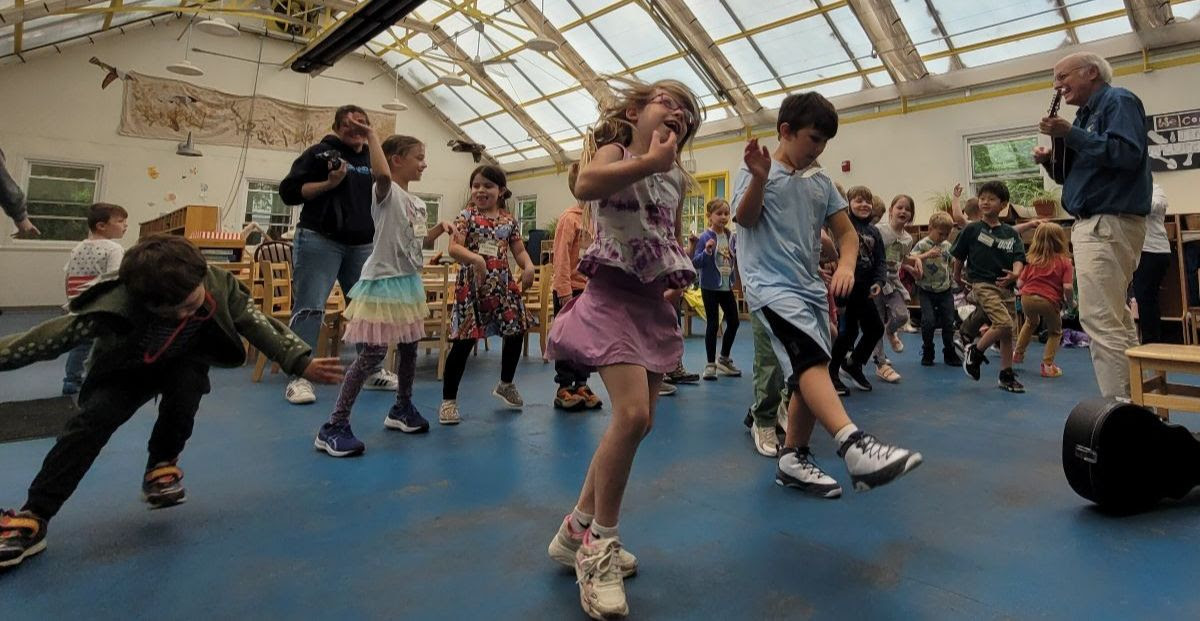
We had an amazing week with the Guitar Man, Jim McCutcheon! He is always a most welcome guest, and teaches the children so much about stringed instruments. Many thanks to the Ohio Arts Council for helping to provide this opportunity, and to our families for providing such delicious food during his residency. This makes our artists feel so welcomed and cared for, and provides valuable time for collaboration and sharing between artists and teachers. We also want to express our thanks to all of our parent volunteers from OFP who made the picnic and concert so enjoyable!


